

STANDARD 2.4
Understand and respect Aboriginal and Torres Strait Islander people to promote reconciliation between Indigenous and non-Indigenous Australians: Demonstrate broad knowledge of, understanding of and respect for Aboriginal and Torres Strait Islander histories, cultures and languages.
artefact 1:
reflective journal
I recognise that understanding and respecting Aboriginal and Torres Strait Islander peoples - and advancing reconciliation - is a responsibility that extends across all curriculum areas, including the arts. International research shows that integrating Indigenous perspectives, histories, and languages into curricula enhances academic and social outcomes for all students (Department of Education, Science and Training, 2007). This aligns with ACARA’s (2025) cross-curriculum priority of Aboriginal and Torres Strait Islander Histories and Cultures, which emphasises the importance of embedding cultural awareness in teaching practice rather than treating it as an add-on.
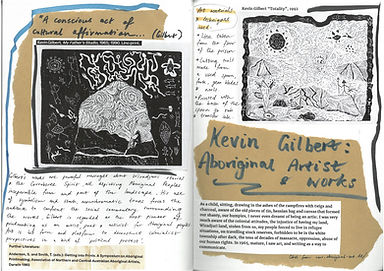
To develop my own cultural responsiveness, Artefact 1 are pages from a reflective journal that captures how I have actively engaged in personal exploration and reflection, ensuring that these experiences inform my approach to learning design.
A key part of this process has been visiting exhibitions such as Wadawurrung Country, Walking Through a Songline, and the Bunjilaka Aboriginal Cultural Centre. I documented these, noting not only the artworks themselves but also how audiences engaged with them. This practice helped me consider the significance of these cultural expressions, as well as their reception within public spaces.




Alongside this, I explored the concept of kinship by creating my own symbolic family tree based on personal ancestry. While distinct from Indigenous knowledge systems, the exercise gave me a deeper appreciation of kinship’s cultural and relational importance in Aboriginal and Torres Strait Islander communities.
These experiences have directly informed my teaching. They have encouraged me to design culturally responsive learning activities that are accessible and meaningful to all students. By engaging personally with these practices and modelling reflective learning, I aim to create classroom environments that support all students in developing cultural awareness and understanding.
I plan to attend professional learning at the National Gallery of Victoria focused on First Nations perspectives and to use resources such as the Koorie Cross-Curricular Protocols to ensure cultural sensitivity.
For Indigenous Australians, art is not merely aesthetic but a powerful expression of identity, cultural values, and sacred connection to Country through the Dreaming. Aboriginal art embodies spiritual and cultural narratives conveyed through visual art, song, dance, and ceremony (Australian Aboriginal Art Gallery, 2020).
This makes the study of Aboriginal art within school visual arts programs essential for nurturing cultural understanding.