

STANDARD 4.3
Manage challenging behaviour: Demonstrate knowledge of practical approaches to manage challenging behaviour.
Challenging behaviour in schools is context-specific, as each school defines its expectations through its student engagement policy. While there is no universal definition, behaviours that threaten the safety or learning of students and staff are generally considered challenging (Department of Education and Training, 2024). These behaviours range from withdrawn actions, such as truancy or social isolation, to disruptive or unsafe behaviours, including aggression, violence, refusal to follow instructions, or inappropriate social interactions (Department of Education and Training, 2024).
Throughout my teacher practicum, I came to understand that student behaviour is shaped by a complex interplay of factors. These include biophysical influences, such as medical conditions or disabilities; psychological factors, including trauma or limited social skills; and social or behavioural patterns reinforced through past experiences (Department of Education and Training, 2024). Furthermore, Lyons et al. (2020) distinguish between positive practices, which focus on proactive strategies to create supportive and inclusive learning environments, and intervention practices, which are used to address challenging behaviours once they arise. Research strongly supports adopting a proactive, preventative approach to classroom management.
Simonsen et al. (2008) highlight five key evidence-based practices for fostering positive behaviour and reducing disruptions:
-
Maximising classroom structure through clear routines and organisation
-
Establishing and explicitly teaching behavioural expectations
-
Actively engaging students in observable and meaningful ways.
-
Acknowledging appropriate behaviour with a continuum of reinforcement strategies.
-
Responding to inappropriate behaviour using a continuum of corrective strategies.
ARTEFACT 1:
SCHOOL BEHAVIOUR POLICIES


Artefact 1 is an excerpt from the school’s handbook on behaviour management and policy. I strongly believe that teachers should prioritise preventative strategies and least intrusive, strength-based approaches when addressing challenging behaviour, as illustrated in the accompanying diagram.
This philosophy closely aligns with the 8 Ways Pedagogical Framework (8 Ways Online, n.d.), which provides a culturally responsive model for developing behaviour management practices that emphasise relational systems rather than punitive measures.This is an approach I aim to embed in my own teaching practice, as it highlights the importance of connection, community engagement, and indirect strategies to support positive student behaviour (Yunkaporta, 2009).
For example, the framework encourages the use of symbols and images to represent classroom rules, non-verbal cues for subtle guidance, and learning maps to track behavioural progress and identify patterns (8 Ways Online, n.d.).Additionally, strategies such as story sharing, community and land links, and deconstruct/reconstruct processes promote cultural relevance while scaffolding students’ capacity for self-regulation.
These strategies align with Positive Behaviour Support (PBS) frameworks, which prioritise building supportive environments rather than relying solely on punitive or reactive discipline. When implemented consistently, PBS has been shown to improve both student behaviour and academic outcomes (Simonsen et al., 2008).
The school’s behaviour management framework is guided by core values of respect, justice, restorative practices, and a strong commitment to child safety. The whole-school approach ensures all staff share responsibility for supporting students to self-manage their behaviour, following a least-to-most intrusive model and upholding expectations both on campus and during school activities. For classroom disruptions, students are referred to leadership through a ‘Go Pass’ system for reflection, discussion, and appropriate consequences, with families informed and restorative practices applied. Their ‘Choose HOPE’ program addresses online behaviour through proactive education and targeted interventions, with escalating responses such as supervised reflection programs, family meetings, and principal interviews.
ARTEFACT 2:
excerpts from STUDENT BEHAVIOUR PLANS
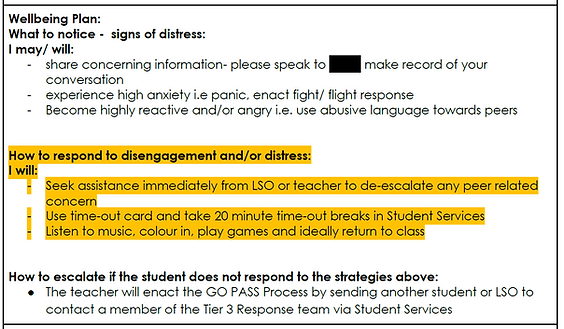


Artefact 2 contains some excerpts from various student behaviour plans that provide knowledge and practical approaches to guide teachers in how to respond if the particular student is showing signs of distress or demonstrating behaviour that requires additional support from leadership, student services or the wellbeing team.
The school has 3 levels of Behaviour Support:
Level 1: Behaviour Agreement
Level 2: Behaviour Contract
Level 3: Behaviour Management Plan
When expectations are explicit and transparent, students are more likely to succeed because they clearly understand what is required of them. I endeavour to improve on defining, modelling, and reinforcing expected behaviours across various contexts, such as group work, transitions, and independent learning tasks. Emmer & Sabornie (2015) suggest that these expectations should be positively stated, concise, and consistently reinforced, ensuring students are equipped to make positive behaviour choices . This approach supports a multi-tiered system, where universal strategies are applied first and more targeted interventions are introduced for students with ongoing behavioural challenges (Simonsen et al., 2008).
I demonstrated this by creating three to five whole-class rules such as “Be respectful, be safe, be responsible” and demonstrating what each looks like in practice (Simonsen et al., 2008). I also engaged in active supervision by moving around the classroom, scanning for potential issues, and offering frequent, positive, non-contingent attention. Specific praise, such as “I like how you’re staying on task during group work,” helped build repoire and also prevented escalation for a positive, inclusion learning environment where everyone felt supported and safe.